

You can visit Malta very successfully without renting a car. In fact, if your trip is centred on Valletta, Sliema, St Julian’s, Mdina, the Three Cities and the main ferry connections, avoiding a car can make the holiday easier. Parking is limited in many historic and coastal areas, traffic can be slow, and driving on the left adds an unnecessary learning curve for some visitors.
The challenge is not whether public transport exists—it does—but how to use it realistically. Malta’s buses reach most places visitors care about, ferries shorten some harbour journeys, and taxis or ride-hailing can fill the gaps. The key is choosing a good base and avoiding itineraries that demand three distant regions in one day.
See Malta without renting a car
Compare current options before you book. Availability and prices can change by date.
Affiliate links: My Malta Trip may earn a commission at no extra cost to you.
At a glance
| Trip style | Best approach |
| City break | Buses + harbour ferries |
| 5–7 days | Travel card + occasional taxi |
| Gozo day trip | Bus + ferry + Gozo bus/taxi |
| Beach holiday | Base near chosen beach + buses |
| Remote coast | Bus out, taxi backup |
Is a car necessary in Malta?
No. Many first-time visitors are better off without one. Valletta is highly walkable, Sliema and St Julian’s have frequent transport links, and harbour ferries connect Valletta with Sliema and the Three Cities. Mdina and Rabat are straightforward by bus, while the north connects to Ċirkewwa for Gozo and Comino departures.
A car becomes more useful when you want several remote beaches, rural viewpoints or small villages in a limited period. Even then, you do not need it for the entire holiday. A hybrid plan—four or five car-free days plus one or two rental days—can be more efficient than paying for parking and rental on days when the vehicle sits unused.
If you do decide to drive later, read our getting around Malta guide before booking so you understand left-side driving, parking and realistic journey times.
Choose your base carefully
Your accommodation choice matters more when you do not have a car. Valletta is excellent for culture, bus connections and harbour ferries. Sliema is strong for restaurants, waterfront life and ferry access to Valletta. St Julian’s suits nightlife and central-east-coast convenience. Mellieħa is better for beaches and the north but less efficient if you plan to visit Valletta every day.
For a first trip of five to seven nights, Valletta or Sliema generally requires the fewest compromises. If the holiday is beach-led, staying near Mellieħa Bay can reduce daily transport even if it makes city sightseeing slower. The mistake is choosing a cheap hotel in an isolated location and then spending the saving on taxis.
Using Malta’s buses in 2026
Malta Public Transport operates the island-wide bus network, including services on Gozo. Current visitor fares and travel products should always be checked on the official fares page. As of September 2026, the official fare table lists a summer day-route cash/contactless fare of €2.50, with a two-hour validity period that allows transfers. It also lists 4-day and 7-day Explore Flex bus bundles, while products and inclusions can change.
Contactless payment makes occasional bus use simple. For heavier use, compare the travel cards rather than automatically buying the first one offered at the airport. A couple making only four bus journeys in three days may spend less paying per trip; a traveller using buses several times daily may benefit from an unlimited product.
Use the Tallinja app or official journey planner for live route planning. Google Maps can be useful for orientation, but when the two disagree on a temporary service change, the operator’s own information should carry more weight.
Airport Direct and Tallinja Direct services
Malta’s network includes faster commercial routes under the Tallinja Direct branding. The current network includes links such as TD2 between the airport and St Julian’s and TD10 between Valletta and Marsaxlokk on Sundays. Airport-focused routes have expanded in recent years, so the best airport bus for your hotel may be different from advice in an older blog post.
Check the route number shortly before arrival. Direct services can cost more than ordinary day buses or have different travel-card rules, but they can save a transfer—often worth it with luggage.
Use ferries whenever they replace a long road journey
Ferries are one of the strongest reasons Malta works without a car. The Valletta–Sliema ferry turns a trip around the harbour into a short boat ride, and the Valletta–Three Cities service is both transport and sightseeing. These routes are especially valuable in summer when road traffic can make a short map distance feel much longer.
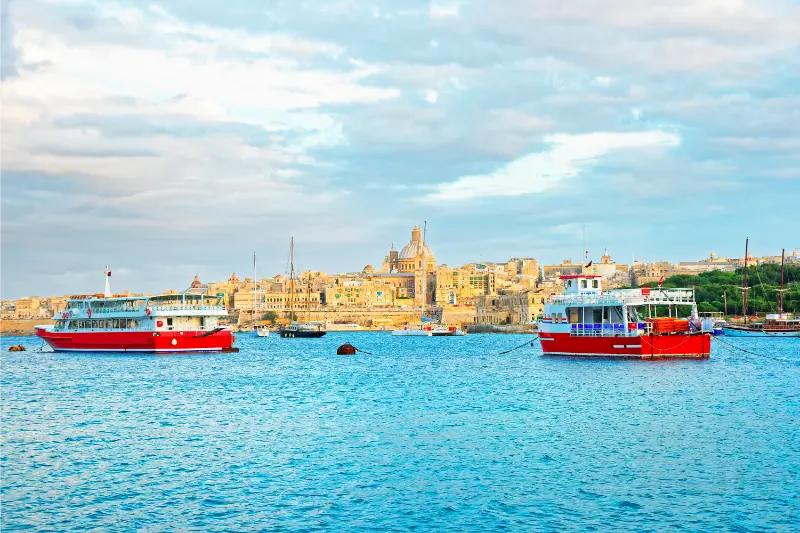
For Gozo, the channel ferry from Ċirkewwa is the classic route and carries foot passengers as well as vehicles. Fast ferry services also connect Valletta and Gozo under current schedules. Decide based on where you are staying: travellers in Valletta may prefer the fast-ferry option, while those based in Mellieħa are already close to Ċirkewwa.
How to reach Mdina and Rabat without a car
Mdina and Rabat are among the easiest major inland destinations without a car. Bus services connect the area with Valletta and other hubs, and once you arrive the two towns are best explored on foot. There is little advantage in driving into the area simply to park and walk the same streets.
Go early in warm months or arrive in the late afternoon and stay into evening. Avoid combining Mdina with Marsaxlokk and Mellieħa in the same day by public transport; the map looks small, but transfers would make the day inefficient.
Gozo without a car
Gozo can be visited without a car, but you need to be selective. Buses radiate from Victoria and reach many key places, yet trying to cover the Citadel, Dwejra, Ramla Bay, Xlendi, Ta’ Pinu and several villages in one day by bus creates too much waiting. Choose two or three priorities.
For a day trip, a practical pattern is ferry → Victoria/Citadel → one coast or beach → return. For two nights, public transport becomes much easier because you can divide the island. An occasional taxi between two remote stops can be a good use of money if it saves an hour and a complicated transfer.
Beaches without a car
Mellieħa Bay is one of the easiest sandy-beach choices by public transport. Golden Bay and Għajn Tuffieħa are also served, but buses can be crowded in high season. For rocky swimming areas, Sliema allows you to walk from many hotels.
Remote coves are where car-free travel requires compromise. A taxi on the return leg can be sensible, particularly after sunset or when a steep coastal walk leaves you tired. Never plan a remote beach day with the assumption that mobile signal, shade and transport will all be perfect.
A realistic 5-day no-car itinerary
- Day 1: Valletta on foot.
- Day 2: ferry to the Three Cities, return to Valletta or Sliema.
- Day 3: bus to Mdina and Rabat.
- Day 4: Gozo, choosing Victoria plus one coastal area.
- Day 5: Mellieħa/Golden Bay or Marsaxlokk depending on weather.
This works because each day has one geographic focus. For a longer trip, add Comino, a second Gozo day or a slower beach day rather than increasing the number of stops per day.
When a taxi is worth the money
The smartest car-free travellers do not insist on using buses for every metre. A taxi is worthwhile for an early airport departure, a late dinner after buses thin out, a remote coastal return or a transfer that avoids two changes. Compare the taxi cost with the time saved, not only with a €2.50 bus fare.
If two or four people are sharing, the per-person difference can become small enough that the taxi is clearly the better choice. Public transport should make the trip cheaper and easier; it should not become a challenge you feel obliged to win.
Frequently asked questions
Can you visit Malta for a week without a car?
Yes. A week is very manageable without a car if you stay in Valletta, Sliema, St Julian’s or another well-connected area. Use buses for Mdina and beaches, ferries for harbour crossings and Gozo, and occasional taxis when a connection is awkward. The trip becomes difficult only when you try to visit several remote places in one day.
What is the best area to stay in Malta without a car?
Valletta and Sliema are the strongest all-round choices. Valletta has the main bus terminal and ferries to Sliema and the Three Cities. Sliema has the Valletta ferry, many bus routes and a wide choice of hotels and restaurants. St Julian’s is excellent for nightlife, while Mellieħa is best when beaches are more important than city sightseeing.
Are Malta buses reliable?
The network is extensive, but traffic means journey times can vary, especially in summer and at commuter peaks. Build buffer time into airport journeys and reservations. Use the official Tallinja app or journey planner and avoid scheduling two timed attractions in distant parts of the island back-to-back.
Is public transport cheap in Malta?
Compared with renting a car plus fuel and parking, buses can be very economical. In September 2026 the official fare table lists the summer day-route fare at €2.50 when paying on board, while several multi-day visitor products are available. Always check current fares before travel because prices and product inclusions can change.
Final thoughts
A car-free Malta trip is not a second-best version of the island. For many visitors it is the more relaxed version. Stay somewhere well connected, group each day geographically, use ferries whenever they make sense and allow yourself the occasional taxi when it buys back meaningful holiday time.