

St Julian’s is one of Malta’s easiest places to book badly because “central” can mean very different things. A hotel near Spinola Bay feels different from one beside Paceville, St George’s Bay or Balluta Bay. All are within the wider St Julian’s area, but noise, nightlife, swimming access and the walk toward Sliema change considerably.
This guide compares the best parts of St Julian’s for couples, nightlife, first-time visitors, families and travellers without a car, then gives concrete hotel examples with affiliate booking links. For the destination itself, see our St Julian’s Malta guide.
Compare St Julian’s accommodation
Rates can change dramatically by season and weekend. Compare the exact map location as carefully as the room price.
Affiliate links: My Malta Trip may earn a commission at no extra cost to you.
Best areas in St Julian’s at a glance
| Area | Best for | Main caution |
| Spinola Bay | Couples, restaurants, atmosphere | Busy promenade |
| Balluta Bay | Quieter evenings, walk to Sliema | Fewer resort-style hotel choices |
| Paceville | Nightlife, clubs, short stays | Noise can be intense |
| St George’s Bay | Beach access, larger hotels | Very close to nightlife zone |
| Dragonara / coast | Resort facilities, sea views | Often higher prices |
Spinola Bay: best overall for atmosphere
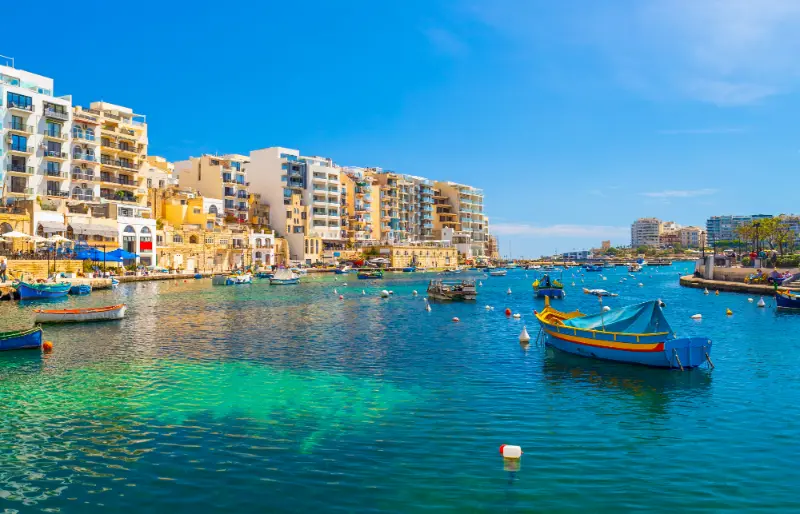
Spinola Bay is the most attractive compromise for many first-time visitors. Restaurants line the waterfront, traditional boats add character and you can walk toward Sliema or uphill toward Paceville. You are close to nightlife without necessarily sleeping directly above it. Couples and food-focused travellers usually find this area more appealing than the busiest club streets.
Hotel Juliani
Best for: couples and travellers who want a boutique base with a strong sense of place. The hotel sits directly in Spinola Bay, with restaurants, bars and transport links immediately outside. Its official site describes it as a family-run boutique property in a renovated townhouse overlooking the bay.
Check current availability and rates for Hotel Juliani on Booking.com →
Balluta Bay: best for a calmer edge of St Julian’s
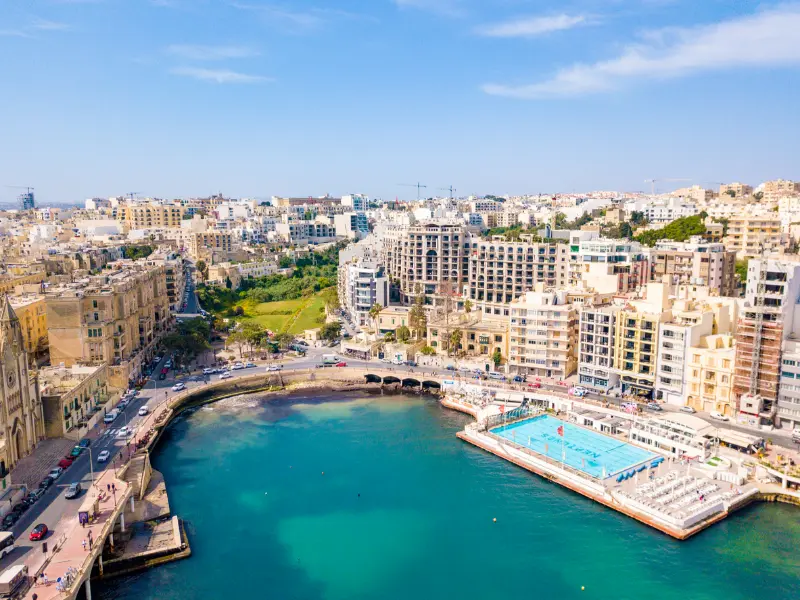
Balluta sits between St Julian’s and Sliema and works well if you want access to both without being surrounded by Paceville. The promenade is excellent for evening walks, buses are frequent and restaurants extend in both directions. It is a strong choice for couples and mature travellers who want a central coastal location but prefer to sleep away from the club district.
Malta Marriott Resort & Spa
Best for: travellers who want resort facilities without giving up a walkable seafront location. The Marriott is at Balluta Bay, a short walk from Sliema and within St Julian’s. Its official information highlights multiple pools, restaurants and a large spa, making it more of a full-service resort than a simple city hotel.
Check current availability and rates for Malta Marriott Resort & Spa on Booking.com →
Paceville: best only if nightlife is the priority
Paceville concentrates clubs, late bars and entertainment. If you are visiting Malta specifically for nightlife, sleeping here is efficient. If you want early mornings, quiet balconies or a relaxed family trip, the same efficiency becomes a disadvantage. Always read recent noise comments and inspect the street-level map before booking.
St George’s Bay: beach plus nightlife access
St George’s Bay gives you one of the few sandy swimming areas in the central resort zone and a cluster of larger hotels. The location is useful for younger travellers and families who value facilities, but it remains close to Paceville. A property can advertise sea or beach proximity while still being near late-night activity, so the exact room orientation matters.
Hyatt Regency Malta
Best for: travellers wanting a modern five-star base close to St George’s Bay, restaurants and nightlife. Hyatt Regency Malta is at Pjazza Santa Rita near St George’s Bay. The official hotel page lists 151 rooms and positions the property as an urban resort within St Julian’s.
Check current availability and rates for Hyatt Regency Malta on Booking.com →
Dragonara and the seafront: best for resort space
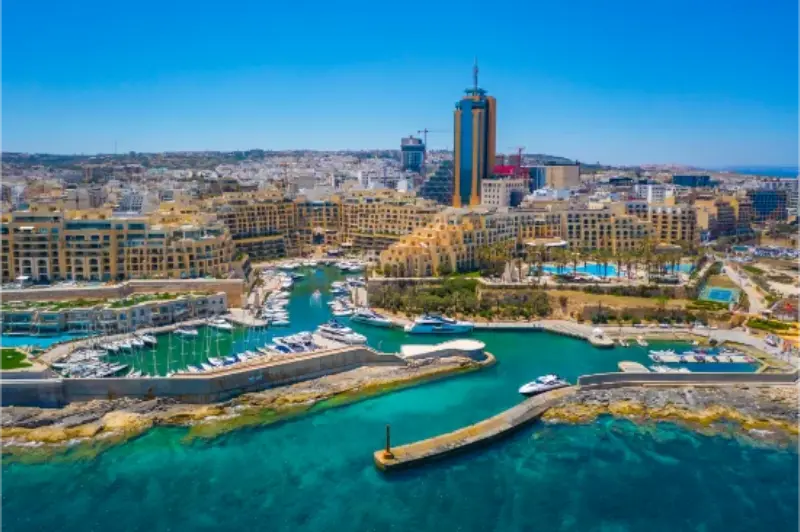
The coastal peninsula around Dragonara has larger resort properties and direct sea orientation. This can suit families and travellers who want pools, sun terraces and hotel restaurants as part of the holiday. You remain close to St Julian’s dining and nightlife, but the experience can feel more self-contained.
St Julian’s for families
Families should avoid choosing the cheapest central room without checking the street. St George’s Bay and the larger coastal resorts can work well, especially if pools and on-site facilities matter, but Paceville itself is a poor fit for many families with young children. Mellieħa generally offers easier access to larger sandy beaches, while Sliema can be better for ferries and daytime transport.
St Julian’s without a car
This is one of Malta’s easiest bases without a car. Buses connect the area widely, Sliema is walkable from Balluta and ferries from Sliema shorten trips to Valletta. The trade-off is traffic: road distances are small, but central congestion can make bus journeys slower than the map suggests. See Malta without a car for itinerary strategies.
How many nights should you stay?
For a four- to seven-night Malta trip, St Julian’s can work as a single base if you enjoy restaurants and evening activity. On longer trips, splitting with Gozo or Mellieħa creates more contrast. Couples who want history by day and dining at night often prefer Spinola or Balluta rather than changing hotels repeatedly.
When St Julian’s is not the best choice
Choose Valletta if you want to step straight into historic streets each morning. Choose Sliema if ferry access and a slightly more practical urban base matter most. Choose Mellieħa for sandy-beach days, or Gozo if quiet evenings and rural scenery are central to the trip. Our where to stay in Malta guide compares all of these bases.
Frequently asked questions
What is the best area of St Julian’s for first-time visitors?
Spinola Bay is the best all-round compromise for many travellers because it combines atmosphere, restaurants, buses and walkability without placing you directly in the busiest club streets.
Is Paceville too noisy to stay in?
It can be, particularly on weekends and in peak season. If sleep matters more than club access, choose Spinola, Balluta or a coastal resort farther from the nightlife core.
Is St Julian’s good for families?
Yes in the right micro-area and hotel, especially properties with pools or near St George’s Bay. Families should avoid booking in the heart of Paceville without understanding the noise.
Is St Julian’s or Sliema better?
St Julian’s is stronger for restaurants and nightlife; Sliema is stronger for the Valletta ferry and a more practical central base. Balluta sits between the two experiences.
Do you need a car in St Julian’s?
No. For many first-time trips a car is more inconvenience than help here because public transport is extensive and parking can be difficult.
Final advice
In St Julian’s, choose the street and micro-area before the hotel brand. A beautiful room in the wrong part of Paceville can undermine the trip; a simpler property in Spinola or Balluta can make every day easier. Use the map, read recent noise comments and decide how much nightlife you genuinely want outside the door.
Extra planning advice
A four-night St Julian’s strategy
Stay around Spinola or Balluta, use the first evening locally, spend one full day in Valletta, one day in Mdina or the Three Cities and one day on the water or at a beach. This works because dinner and evening atmosphere are already solved near the hotel. You do not need to return from each day trip and start researching another neighbourhood.
How to read hotel reviews here
Filter recent reviews for noise, room orientation, construction and air-conditioning rather than looking only at the overall score. A five-star property can still have a room facing late-night activity, while a smaller hotel one street back can be quieter. For Paceville, weekend reviews are especially useful because weekday experiences may understate nightlife noise.
Before you leave the hotel
- Recheck the official opening or operating information for the day.
- Save the address and your return transport option offline.
- Carry water and sun protection for any outdoor sections.
- Keep enough time between timed tickets and transport connections.
- Use the exact location rather than relying only on the attraction or district name.
Malta is compact, but small delays add up quickly when a day contains timed tickets, buses, ferries or parking. A ten-minute planning check before leaving can prevent an hour of unnecessary backtracking. Keep the day focused on one or two priorities and let the rest remain optional; this produces a more enjoyable trip than treating every nearby attraction as compulsory.
One final principle applies especially well here: build around the experience that cannot easily move, then keep meals, viewpoints and secondary stops flexible. Opening hours, weather and traffic can change even when distances are short. A plan with a clear priority and spare time is more resilient than a minute-by-minute itinerary, and it leaves room for the small discoveries that often become the most memorable part of Malta.
How to make this stop work in a real itinerary
Treat this guide as a planning tool rather than a list of obligations. Malta rewards short distances on the map only when transport, heat, opening times and the pace of your group are considered together. Put the most time-sensitive experience first, leave a buffer before the next commitment and keep at least one nearby alternative that does not require a reservation. This gives you room to respond to weather or tiredness without feeling that the day has failed. It also makes it easier to enjoy cafés, viewpoints and neighbourhood streets that are often missed when every hour is pre-booked.