

Few places in Malta combine archaeology and landscape as powerfully as Ħaġar Qim and Mnajdra. The two megalithic temple complexes stand on the island’s south-western coast, with open sea views and the small island of Filfla visible offshore. The setting makes the prehistoric architecture feel connected to the terrain rather than isolated inside a museum.
The sites are more than 5,000 years old and form part of Malta’s UNESCO-listed Megalithic Temples. Ħaġar Qim sits higher on the ridge, while Mnajdra lies around 500 metres downhill. A Visitor Centre provides context before you walk through the temple structures, and modern protective shelters reduce the impact of weather on the limestone.
This is one of Malta’s essential visits for anyone interested in history, but it also appeals to travellers who simply want a distinctive half-day outside the cities. The practical challenge is not complexity; it is allowing enough time, handling the walk between the two temples and planning for sun, wind and uneven terrain.
At a glance
- Two UNESCO-listed temple complexes more than 5,000 years old, about 500 metres apart.
- Current combined admission: €10 adults; €7.50 youths, seniors, concessions and students; €5.50 children aged 6–11; infants free.
- Heritage Malta says the Visitor Centre and Ħaġar Qim are accessible with assistance; Mnajdra is not fully accessible.
- Allow 90 minutes to three hours depending on pace, interpretation and how long you spend at Mnajdra.
- The closest bus stop is roughly three minutes on foot from the archaeological park.
Why visit Ħaġar Qim and Mnajdra?
Ħaġar Qim and Mnajdra earns a place in a Malta itinerary because it adds context that is difficult to get from photographs alone. The best visit is not about collecting another landmark; it is about understanding how this place fits into the island’s history, landscape and everyday geography. If your schedule is tight, make this one of the stops you plan deliberately rather than something you squeeze between unrelated attractions.
Before leaving your accommodation, recheck the Heritage Malta Ħaġar Qim and Mnajdra visitor information. Opening arrangements, event closures, restoration work and ticket conditions can change. My Malta Trip uses current information when this guide is prepared, but the official operator is always the final source for same-day access.
History and context
Both sites date to the late Neolithic and were built by communities living on the Maltese Islands long before the Bronze Age, Phoenicians, Romans or Knights. Their builders moved and shaped enormous limestone blocks without metal tools or modern machinery, creating chambers, thresholds and carefully organised internal spaces.
Ħaġar Qim and Mnajdra were not identical projects. They were built and modified at different times, and the stone types differ in parts of the complexes. Archaeologists have also identified astronomical relationships at Mnajdra: the South Temple is aligned so that sunlight interacts with the doorway and interior during equinoxes and solstices. The alignments are a striking example of how architecture, season and ritual may have been connected.
What to see
Ħaġar Qim’s monumental façade
The first major impression is scale. Massive uprights and horizontal lintels create a façade that still feels deliberate and imposing after thousands of years. Look closely at doorways cut through single blocks and at the relationship between the outer wall and internal chambers. The plan is more complex than it first appears.
Views toward Filfla
From the ridge around Ħaġar Qim, the Mediterranean is part of the experience. Filfla sits offshore and provides a strong visual anchor. The landscape helps explain why this archaeological park feels so different from Tarxien, which is surrounded by modern urban development.
The walk to Mnajdra
The roughly 500-metre path between the complexes is not wasted transit. It gives you time to understand the scale of the coastal setting and separates the two architectural experiences. In summer, however, the exposed path can feel much longer under intense sun, so carry water and avoid treating the walk casually.
Mnajdra’s three structures
Mnajdra contains three temple structures built at different stages. The South Temple is the best-known because of its solar alignments, but the entire complex rewards a slow circuit. The lower coastal position gives it a more secluded feeling than Ħaġar Qim.
The Visitor Centre
Do not skip the Visitor Centre. Prehistoric architecture can be difficult to interpret without a timeline and site plan. The exhibits explain construction, chronology, ritual interpretation and conservation, making the stones outside much more meaningful. Starting here is usually better than visiting it only after the temples.
Compare Malta prehistoric temple tours
If you do not want to coordinate buses or driving, a guided archaeology tour can combine Ħaġar Qim and Mnajdra with other southern sites and hotel pickup.
Affiliate links: My Malta Trip may earn a commission at no extra cost to you.
How to plan your visit
Heritage Malta says a visit can take from around ninety minutes to as much as three hours. For most first-time visitors, two hours is a good target: enough to use the Visitor Centre, explore Ħaġar Qim, walk to Mnajdra and return without rushing. Add more if you are deeply interested in archaeology or photography.
Start early in warm weather. The shelters protect the temples themselves, but the path between them is outdoors and exposed. In cooler months, the site is excellent later in the day when the limestone takes on warmer colour. Wind can be strong on the coast, so the perceived temperature may differ from sheltered inland towns.
How to get there
The archaeological park is near Qrendi on Malta’s south-west coast. Public transport is possible, and Heritage Malta notes that the closest stop is only a few minutes on foot. The journey is easiest if you check current route planning rather than assuming one direct bus from every resort area.
A rental car is useful if you want to combine the temples with Blue Grotto, Dingli or other southern and western sites. An organised tour can also make sense because these attractions are spread out. If your day is only Ħaġar Qim and Mnajdra, however, you do not need a car purely for the archaeological park.
Accessibility and visiting with children
Accessibility differs between the two temple groups. Heritage Malta states that the Visitor Centre and Ħaġar Qim are accessible, though assistance may still be needed, while Mnajdra is not fully accessible. The slope and path between the sites are the main issue for visitors with reduced mobility.
Families can enjoy the park if the visit is paced well. The giant stones and open setting are more immediate than rows of artefacts behind glass. Use the Visitor Centre first, then give children simple things to look for—doorways, enormous blocks, different chamber shapes—rather than expecting them to follow a long archaeological lecture.
What to combine nearby
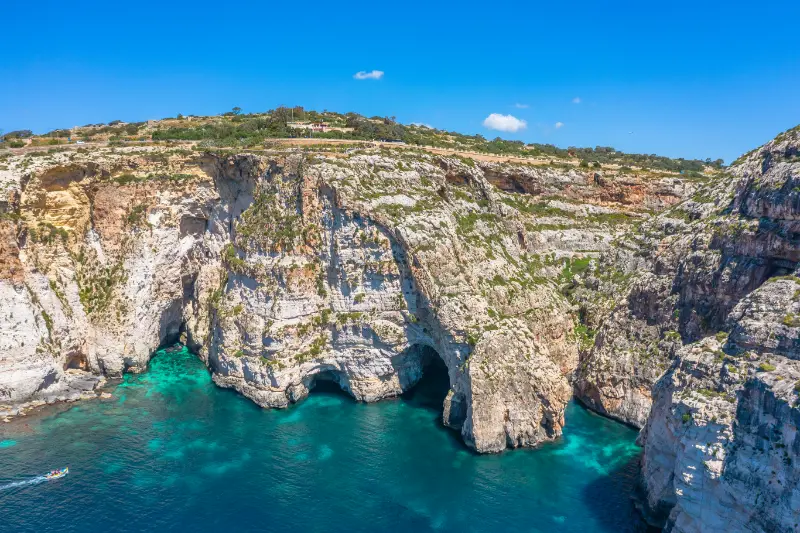
The most obvious extension is the Blue Grotto, which lies in the same general part of the island. Boat trips depend on sea conditions, so keep the archaeology as the reliable anchor of the day and treat the grotto boat as weather-dependent.
For comparison with a different temple setting, visit Tarxien Temples. Tarxien has denser carved decoration and an urban environment; Ħaġar Qim and Mnajdra are stronger for landscape, monumental scale and the relationship between architecture and the sun.
Practical tips
- Use the Visitor Centre before the temples so the layout and chronology make sense.
- Carry water and sun protection even though the temple structures are covered; the path to Mnajdra is exposed.
- Wear shoes suitable for slopes and uneven outdoor surfaces rather than beach sandals.
- Check Heritage Malta’s live opening schedule and any special notices before travelling.
- If you want to experience an equinox or solstice event, look for official Heritage Malta programming rather than assuming ordinary access at sunrise.
A useful rule in Malta is to leave more time between stops than the map suggests. Short distances can involve traffic, steep streets, parking searches, ferry timing or a bus connection. If this attraction is one of your priorities, protect it with a generous buffer and make the rest of the day flexible. That is especially important in summer, when heat slows walking and popular sites are busiest.
Is it worth adding to your Malta itinerary?
For most travellers interested in the subject, the answer is yes. Ħaġar Qim and Mnajdra works best when it complements rather than duplicates the rest of your trip. Pair it with one or two nearby places, then leave room for a meal, a viewpoint or an unplanned walk. Malta is small enough that overplanning is tempting, but the islands are much more enjoyable when a day has a clear theme instead of six unrelated stops.
If you are choosing between several attractions, think about what your itinerary already contains. A trip heavy on churches may benefit from a fort, archaeological site or beach; a beach-focused holiday may become more memorable with one strong cultural visit. The goal is not to see everything, but to create contrast and understand the islands from more than one angle.
Frequently asked questions
Are Ħaġar Qim and Mnajdra on the same ticket?
Yes. They form one archaeological park with a shared Visitor Centre, and standard admission covers the two complexes.
How far apart are they?
Heritage Malta states that Mnajdra is about 500 metres downhill from Ħaġar Qim along a connecting footpath.
How much are tickets?
The current standard adult admission is €10, with reduced rates for youths, seniors, concessions and children.
How long should you spend?
Plan roughly two hours for a balanced visit. Faster visitors may manage around ninety minutes, while archaeology enthusiasts can easily spend three hours.
Is the site wheelchair accessible?
The Visitor Centre and Ħaġar Qim have accessible provision, though assistance may be needed. Mnajdra is not fully accessible because of the route and terrain.
Final advice
Give Ħaġar Qim and Mnajdra enough time to be more than a photograph. Check official information shortly before leaving, keep transport realistic and use nearby sights to build one coherent half-day or day. That approach usually produces a better experience than racing across Malta or Gozo simply because distances look short on a screen.