

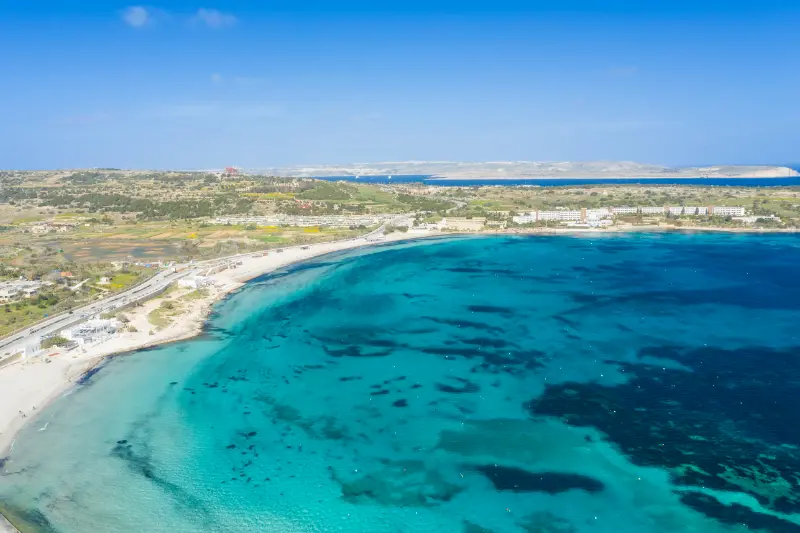
Mellieħa Bay, also called Għadira Bay, is the beach many first-time visitors imagine when they think of an easy Malta beach day: sand rather than rock, a broad shoreline and shallow water that lets swimmers enter gradually. It is also one of the island’s most practical beaches for families and travellers who do not want to climb long staircases or scramble over stone.
The bay sits below Mellieħa village on the route toward Ċirkewwa, making it easy to reach by public transport and convenient if you are staying in northern Malta. Its accessibility is a strength, but it also means the beach becomes very busy in high summer. If you want solitude, this is not the right place; if you want convenience, it is one of the strongest choices.
This guide covers the practical differences between Mellieħa Bay and Malta’s more scenic or rocky swimming spots, when to arrive, what to expect with children and how to combine a beach day with Popeye Village, Mellieħa village or northern boat trips.
At a glance
- Also known as Għadira Bay, on Malta’s north coast below Mellieħa.
- One of Malta’s largest and easiest sandy beaches, with a long shallow entry that suits families.
- Popular for swimming, paddle sports and relaxed beach days; conditions still depend on wind and weather.
- Well served by buses on the main northbound route toward Ċirkewwa.
- Best for: families, first-time visitors wanting sand, easy water access and nearby accommodation.
Why visit Mellieħa Bay Malta?
Mellieħa Bay Malta earns a place in a Malta itinerary because it adds context that is difficult to get from photographs alone. The best visit is not about collecting another landmark; it is about understanding how this place fits into the island’s history, landscape and everyday geography. If your schedule is tight, make this one of the stops you plan deliberately rather than something you squeeze between unrelated attractions.
Before leaving your accommodation, recheck the Visit Malta tourism information. Opening arrangements, event closures, restoration work and ticket conditions can change. My Malta Trip uses current information when this guide is prepared, but the official operator is always the final source for same-day access.
History and context
Għadira Bay sits within a part of northern Malta shaped by beaches, wetlands, agricultural land and later tourism development. The area behind the beach includes the Għadira nature reserve, an important protected habitat that gives the wider bay more ecological interest than the resort frontage alone suggests.
Mellieħa developed into one of Malta’s main holiday areas partly because of this beach. Hotels and apartments spread across the village, bay and northern coast, while the sandy shoreline remained the centre of summer activity. Today it is a good example of a Maltese beach that functions both as a natural bay and as a major visitor resort.
What to see
The long sandy shoreline
Malta has fewer large sandy beaches than many visitors expect, so Mellieħa Bay stands out. There is more room to spread out than at tiny coves, though July and August still bring dense crowds. Sand makes it easier for children and for travellers who dislike rocky entries.
Shallow water
The gradual entry is one of the bay’s main advantages. Children can often paddle in shallower sections, and less-confident swimmers may find the beach less intimidating than cliff-backed coves. Never assume ‘shallow’ means automatically safe: wind, waves and local warnings still matter.
Water activities
The beach is associated with seasonal water sports and rentals, from paddle activities to small craft. Availability depends on time of year and weather. If a specific activity matters, check operators on the day rather than building your entire itinerary around an online listing from months earlier.
Easy public transport
Buses running through northern Malta make Mellieħa Bay one of the simplest sandy beaches to reach without a car. This is a major advantage over smaller coves that require long walks or infrequent connections. In summer, however, buses can be crowded, so allow flexibility on the return journey.
Sunset and evening atmosphere
The bay can be pleasant after the peak daytime rush. If you are staying nearby, consider arriving later for a swim and staying into early evening. Day-trippers usually leave before overnight guests, and the temperature becomes more comfortable.
Plan a Mellieħa beach stay or north-coast activity
Mellieħa is a useful base for beaches, Comino excursions and family holidays. Compare the exact hotel location because the village sits uphill from the bay.
Affiliate links: My Malta Trip may earn a commission at no extra cost to you.
How to plan your visit
In July and August, arrive early if you want a convenient position and less intense heat. By late morning the beach can be crowded, particularly on weekends and during school holidays. Shoulder-season visits are easier, but water temperature and sea conditions may be less predictable.
Families should treat shade as a priority rather than an optional extra. Bring or rent appropriate sun protection, use high-SPF sunscreen and plan breaks away from direct midday sun. A long beach day is enjoyable only if children are not exhausted by heat before lunch.
How to get there
Mellieħa Bay lies directly on the main road through northern Malta and is served by buses connecting Valletta, Sliema/St Julian’s, St Paul’s Bay, Mellieħa and Ċirkewwa. Travel times can be long from the south because of traffic, so staying in the north makes repeat beach visits much easier.
Drivers have more flexibility for early starts and nearby stops, but summer parking pressure is real. If your holiday is mainly beaches in the north and Gozo, a car may be useful; if you are based in Valletta and only want one beach day, public transport or a taxi may be simpler.
Accessibility and visiting with children
Compared with beaches reached by steep stairs, Mellieħa Bay is relatively straightforward. The sandy surface itself can still be difficult for wheelchairs or mobility aids, and the exact accessibility of seasonal facilities should be checked locally.
For small children, the bay’s combination of sand, shallower water and nearby services is difficult to beat. It features prominently in our best family beaches in Malta and Malta with Kids guides for that reason.
What to combine nearby
Mellieħa village sits uphill from the bay and deserves time for its views, church and local atmosphere. If you are staying in the area, read Where to Stay in Mellieħa before choosing between village accommodation and hotels closer to the water.
Popeye Village at Anchor Bay is another natural family pairing, though it is a separate attraction rather than a beach extension. Northern boat departures toward Comino and Gozo also make this a useful base for travellers who want sea-focused days.
Practical tips
- Arrive early in peak summer if you want a quieter swim and easier parking or bus capacity.
- Check flags, lifeguard information and sea conditions on the day; a normally gentle bay can still change with weather.
- Bring footwear for hot sand and nearby paved areas, even if you plan to swim barefoot.
- Do not leave valuables unattended while everyone in your group is in the water.
- Consider late afternoon if you are staying nearby; the beach often becomes more pleasant after the hottest part of the day.
A useful rule in Malta is to leave more time between stops than the map suggests. Short distances can involve traffic, steep streets, parking searches, ferry timing or a bus connection. If this attraction is one of your priorities, protect it with a generous buffer and make the rest of the day flexible. That is especially important in summer, when heat slows walking and popular sites are busiest.
Is it worth adding to your Malta itinerary?
For most travellers interested in the subject, the answer is yes. Mellieħa Bay Malta works best when it complements rather than duplicates the rest of your trip. Pair it with one or two nearby places, then leave room for a meal, a viewpoint or an unplanned walk. Malta is small enough that overplanning is tempting, but the islands are much more enjoyable when a day has a clear theme instead of six unrelated stops.
If you are choosing between several attractions, think about what your itinerary already contains. A trip heavy on churches may benefit from a fort, archaeological site or beach; a beach-focused holiday may become more memorable with one strong cultural visit. The goal is not to see everything, but to create contrast and understand the islands from more than one angle.
Frequently asked questions
Is Mellieħa Bay good for families?
Yes. The sandy beach and gradual water entry make it one of Malta’s easiest choices for families, though normal water-safety and sun precautions still apply.

Is it sandy?
Yes. Mellieħa Bay is one of Malta’s largest sandy beaches and is very different from the island’s many rocky swimming platforms.
Can you get there by bus?
Yes. It is directly served by major northbound bus routes, making it one of the most practical beaches without a car.
How long should you stay?
Anything from a two-hour swim to a full beach day works. Families often prefer a morning session with a break during peak afternoon heat.
Where should you stay nearby?
Mellieħa village offers restaurants and elevated views, while accommodation closer to the bay is more convenient for repeated beach access.
Final advice
Give Mellieħa Bay Malta enough time to be more than a photograph. Check official information shortly before leaving, keep transport realistic and use nearby sights to build one coherent half-day or day. That approach usually produces a better experience than racing across Malta or Gozo simply because distances look short on a screen.