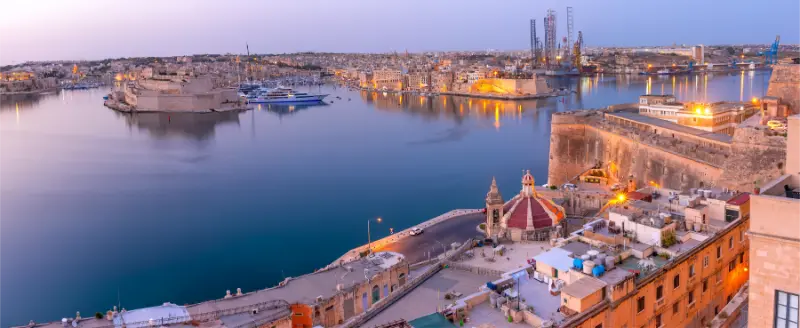
Fort St Elmo is the best single place in Valletta to connect Malta’s military history with the geography of its two harbours. The fort occupies the tip of the peninsula, guarding the approaches to Grand Harbour and Marsamxett Harbour. Inside, the National War Museum follows Maltese military history across thousands of years, with particular strength in the Great Siege and Second World War.
It is a larger visit than many travellers expect. This guide covers current admission, how much time to allow, what is temporarily unavailable, accessibility and how to decide whether Fort St Elmo fits your Valletta day.
Fort St Elmo at a glance
| Question | Practical answer |
| Location | Mediterranean Street, tip of Valletta peninsula |
| Visit length | Allow at least 1.5–2 hours |
| Adult admission | €10 at time of writing |
| Senior/youth/student | €7.50 at time of writing |
| Children 6–11 | €5.50; infants 1–5 free |
| Ticket | Includes both Fort St Elmo and National War Museum |
| Accessibility | Partial; some roofs, cells and sections require stairs |
| Current notice | WWI display in Section 4 is closed until further notice |
Heritage Malta currently lists Fort St Elmo as closed on Friday 11 September 2026. It also notes that the WWI display within Section 4 is temporarily closed. Check Heritage Malta immediately before visiting.
Add a guided Valletta experience
Fort St Elmo can be visited independently, but a Valletta history tour can help connect the fort to the Great Siege, the Knights and the rest of the fortified capital.
Affiliate links: My Malta Trip may earn a commission at no extra cost to you.
Why Fort St Elmo is historically important
The fort’s strategic position was recognised before modern Valletta existed. During the Great Siege of 1565, the struggle for St Elmo became one of the defining episodes of the conflict. The later city of Valletta grew behind this exposed point, and the fort continued to evolve through successive military periods. Its history therefore gives a useful framework for understanding why so much of Malta’s architecture faces the sea defensively.
The site also remained relevant far beyond the Knights. Heritage Malta notes that Fort St Elmo suffered Malta’s first aerial bombardment of the Second World War on 11 June 1940. That long military continuity makes it a logical home for the National War Museum.
What you see in the National War Museum
The museum is arranged chronologically through several sections, covering Maltese military history from early periods to the twentieth century and beyond. The Second World War has a particularly strong presence. Among the best-known objects are the Gloster Sea Gladiator Faith, Roosevelt’s Jeep “Husky” and Malta’s George Cross.
The most successful way to visit is not to read every panel. Choose two or three periods you care about, then use the fort architecture and harbour views as pauses between galleries. If you try to absorb seven thousand years line by line, museum fatigue arrives before you reach the sections that may matter most to you.
The Great Siege section
For many travellers, the Great Siege is the key reason to visit. Heritage Malta states that Section 2, covering the early Knights period and Great Siege, reopened from 1 August 2026. This makes the fort a much stronger companion to St John’s Co-Cathedral, where the Order’s religious and artistic identity dominates instead.
Views from the fort
Do not rush through the exterior sections. Fort St Elmo gives unusual perspectives over both major harbours and toward the surrounding fortified towns. The views are historically meaningful rather than merely scenic: you are standing on the point that controlled maritime approaches to the capital. In clear weather, this is one of the best places to understand Valletta as a defensive peninsula.

How long to allow
Heritage Malta recommends at least 1.5 hours for a good look at both fort and museum. For most first-time visitors, two hours is more comfortable. Military-history enthusiasts could spend longer. If you have only 45 minutes, Fort St Elmo is not an ideal choice; use the Upper Barrakka Gardens for a shorter fortified-harbour experience instead.
Accessibility and physical effort
The site is partially accessible. Heritage Malta notes that the Cavalier roof, prison cells and parts of the Abercrombie bastions are reached by steps, and one museum section also requires stairs. Other parts benefit from lifts or chair lifts. If step-free access to a particular gallery is essential, contact the museum before visiting because “partially accessible” can mean different things depending on your needs.
In Guardia historical re-enactments
Selected Sundays host the In Guardia historical re-enactment. Heritage Malta currently lists scheduled dates in October, November and December 2026, with the performance beginning at 11:00 and museum access handled differently on those event days. This can be a memorable addition if your dates align, but it changes normal timing, so check the current event schedule rather than assuming Sunday works like an ordinary museum day.
What to combine with Fort St Elmo
Fort St Elmo works best as the far end of a Valletta walking route. Start around the Upper Barrakka Gardens, visit St John’s Co-Cathedral, then continue toward the fort. That avoids unnecessary backtracking. Afterward, the waterfront or Lower Barrakka area gives you a slower finish.
Is it good for families?
Older children interested in battles, aircraft, forts and real objects often enjoy St Elmo more than a conventional art museum. Younger children may tire because the site is spread out and includes multiple galleries. Build in outdoor breaks, carry water in warm weather and do not schedule another major museum immediately afterward.
Frequently asked questions
Does the Fort St Elmo ticket include the National War Museum?
Yes. Heritage Malta states that the ticket covers both the fort and the National War Museum.
How much is admission?
At the time of writing, adult admission is €10, with reduced rates for seniors, youths, students and children. Always confirm current prices before visiting.
How long does Fort St Elmo take?
Allow at least 1.5 hours; around two hours is better for most visitors who want both museum galleries and exterior views.
Is Fort St Elmo fully wheelchair accessible?
No. The site is partially accessible and some areas require stairs, although lifts or chair lifts serve other sections.
Is Fort St Elmo worth it if I am not interested in war history?
It can still be worthwhile for the fort architecture and harbour geography, but travellers with limited time may prefer St John’s Co-Cathedral or the Upper Barrakka Gardens if military history holds little interest.
Final advice
Fort St Elmo is most rewarding when you give it enough time and arrive with a basic sense of Malta’s history. It is not just another museum building: the setting is one of the objects. Use the galleries to understand the conflicts, then step outside and look at the harbours those conflicts were fought to control.
Extra planning advice
A realistic museum-day strategy
Do not combine Fort St Elmo with three other large museums. Pair it with one major interior such as St John’s and use outdoor streets, gardens and lunch as recovery between them. If history is the entire purpose of your visit, add the Three Cities on a separate day so Fort St Angelo and Birgu have enough time to register as places rather than extra checklist items.
What to bring
Comfortable shoes matter because the fort spreads across indoor and outdoor levels. In warm months, carry water and sun protection even though much of the interpretation is indoors. A light layer can be useful in cooler months because the peninsula is exposed to wind. Keep your bag compact: moving through historical structures is easier without unnecessary luggage.
Before you leave the hotel
- Recheck the official opening or operating information for the day.
- Save the address and your return transport option offline.
- Carry water and sun protection for any outdoor sections.
- Keep enough time between timed tickets and transport connections.
- Use the exact location rather than relying only on the attraction or district name.
Malta is compact, but small delays add up quickly when a day contains timed tickets, buses, ferries or parking. A ten-minute planning check before leaving can prevent an hour of unnecessary backtracking. Keep the day focused on one or two priorities and let the rest remain optional; this produces a more enjoyable trip than treating every nearby attraction as compulsory.
One final principle applies especially well here: build around the experience that cannot easily move, then keep meals, viewpoints and secondary stops flexible. Opening hours, weather and traffic can change even when distances are short. A plan with a clear priority and spare time is more resilient than a minute-by-minute itinerary, and it leaves room for the small discoveries that often become the most memorable part of Malta.
How Fort St Elmo fits into Valletta’s geography
The fort makes more sense when you notice its position at the tip of the Sciberras peninsula. From here, the entrances to both Grand Harbour and Marsamxett Harbour can be understood in a way that maps do not quite convey. After the museum, walk a short stretch back toward central Valletta and look again toward the Three Cities. The defensive logic of the capital becomes much easier to read once you have physically stood at St Elmo. This is one reason the fort works best as part of a walking day rather than as an isolated museum stop reached and left by taxi.